
1. Adding Too Many Control Points
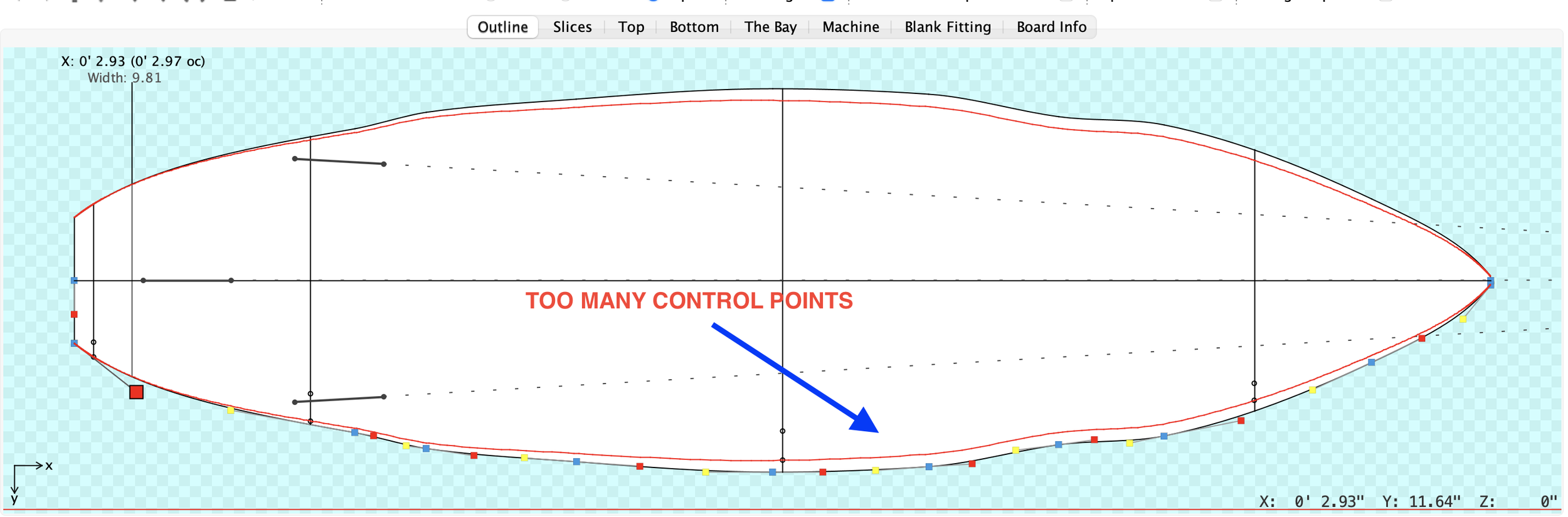
One of the biggest mistakes beginners make is assuming more control points equal more control. In reality, the opposite is often true.
Adding unnecessary guide points creates tiny inconsistencies between points that are difficult to see on screen but become obvious once the board is shaped. These "wobbles" can affect the outline, rocker, or rail curves.
Tip:
Use the minimum number of control points needed to create a smooth curve. If you're constantly adjusting small sections of the curve, you probably have too many points.
2. Using Too Many Cross Sections (Slices)
More slices don't necessarily produce a better design.
Each slice introduces another transition that must blend into the next. Too many slices can create subtle flat spots or bumps in the bottom contours and rails.
A good habit is to rotate the board and look down the stringer or rail, just as you would in the shaping bay. Irregular transitions become much easier to spot from this perspective.
3. Designing Too Much Rocker
Many new designers are tempted to add extra nose rocker because it looks "performance oriented."
In reality, excessive rocker slows paddling, reduces speed, and often makes boards feel sticky unless designed for very specific waves.
Compare your design with proven boards.
Measure boards in your rack.
Compare rocker numbers.
Reference professional dimensions before reinventing the wheel.
4. Ignoring Blank Selection
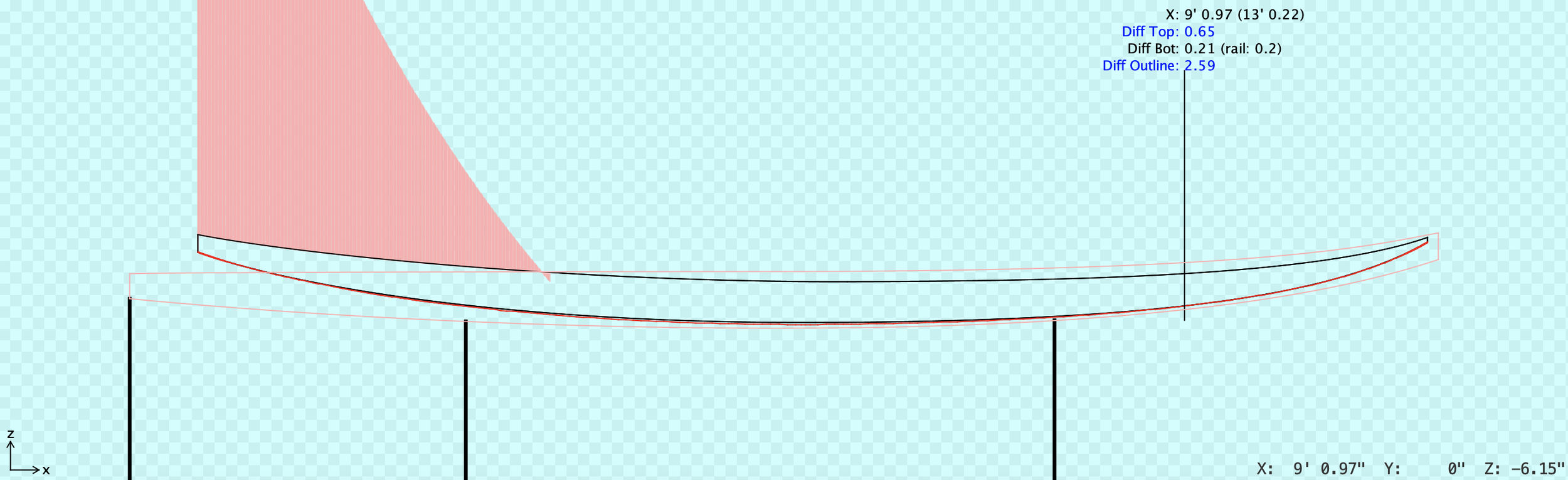
A beautiful design isn't much use if it doesn't fit a production blank.
Poor blank selection leads to:
wasted foam
unnecessary machining
extra hand shaping
slower production
higher costs
Always check your blank fit before finalizing the design.
AkuShaper's Blank Fitting tools make it easy to compare different blanks and find the most efficient option.
5. Making the Nose or Tail Too Thin
Not every CNC machine cuts the same way.
Some machines require a minimum nose and tail thickness to hold the blank securely during machining.
Always ask your CNC operator:
"What nose and tail thickness do you recommend?"
It can save expensive machining problems later.
6. Forgetting to Save Build Notes
The board file isn't just a shape.
It's your production record.
Use the Board Info tab to record:
customer weight
surfer ability
wave type
fin setup
glass schedule
blank used
customer feedback
special requests
Six months later you'll thank yourself.

7. Designing Without a Real Board Beside You
Some of the best designers constantly compare against physical boards.
CAD makes experimentation easy, but having a favorite board nearby gives you a reality check.
Measure:
rocker
rail thickness
foil
wide point
volume distribution
Don't rely on memory.
8. Chasing Numbers Instead of Curves
Volume.
Width.
Thickness.
These numbers matter...
…but curves matter more.
Two boards can have identical dimensions while surfing completely differently.
Spend more time studying:
outline flow
rocker flow
foil
rail curves
bottom contours
Great boards are defined by curves—not just numbers.
9. Never Looking at the Board in 3D
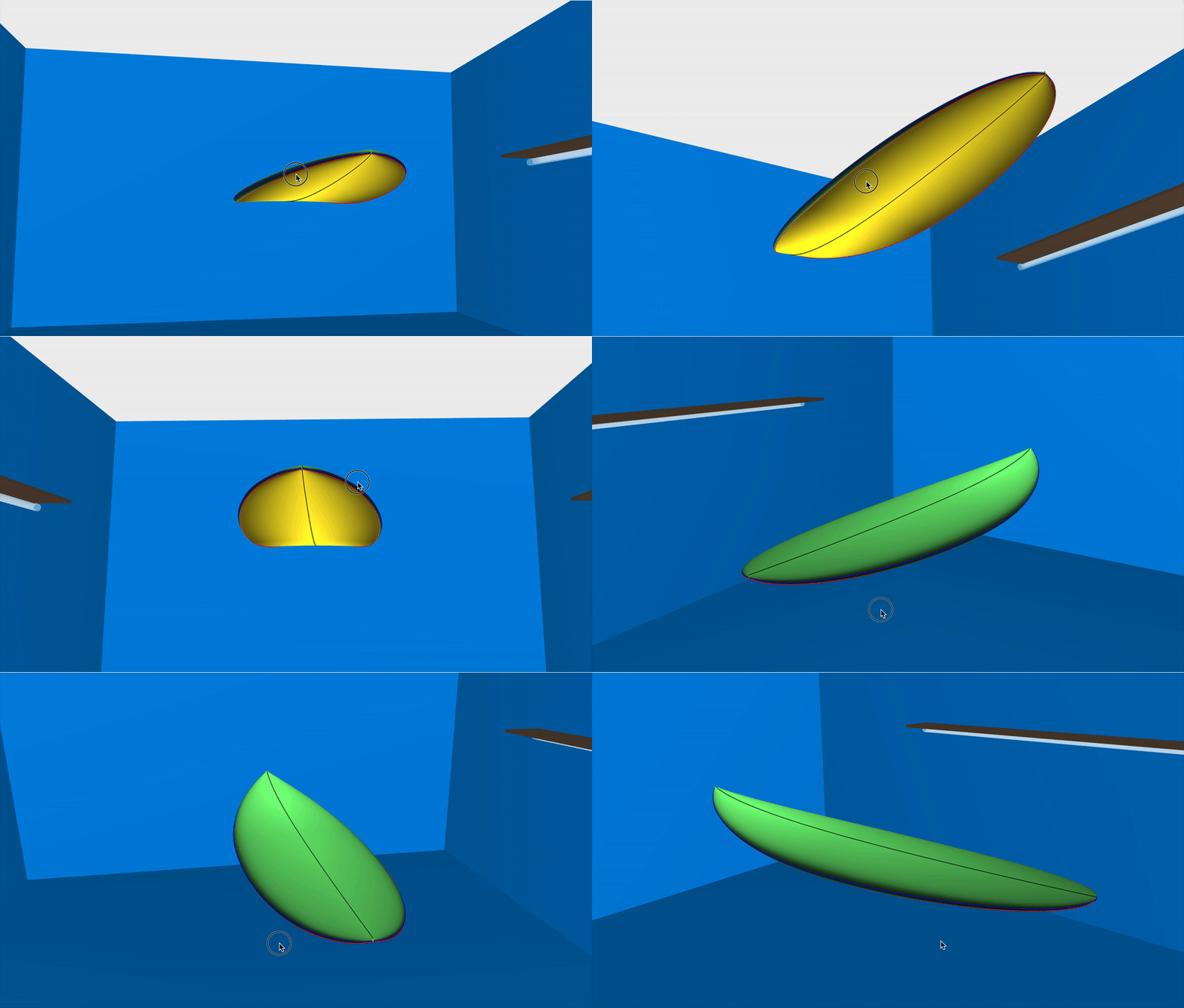
Many designers spend all their time in side and plan view.
The 3D view often reveals:
uneven rails
awkward concaves
bumps
twist
awkward transitions
Rotate the board constantly.
Look from every angle.
10. Never Building What You Design
The fastest way to improve isn't another tutorial.
It's shaping the board.
Every board you build teaches something that CAD alone never can.
Design.
Shape.
Surf.
Repeat.

BONUS POINT
Trying to create the perfect board from scratch.
Many new users treat every design as a blank canvas.
Experienced shapers usually do the opposite.
They start with a proven design, make one or two changes, build it, surf it, and repeat.
Surfboard design is iterative. Small refinements over many boards almost always outperform radical changes from one design to the next.